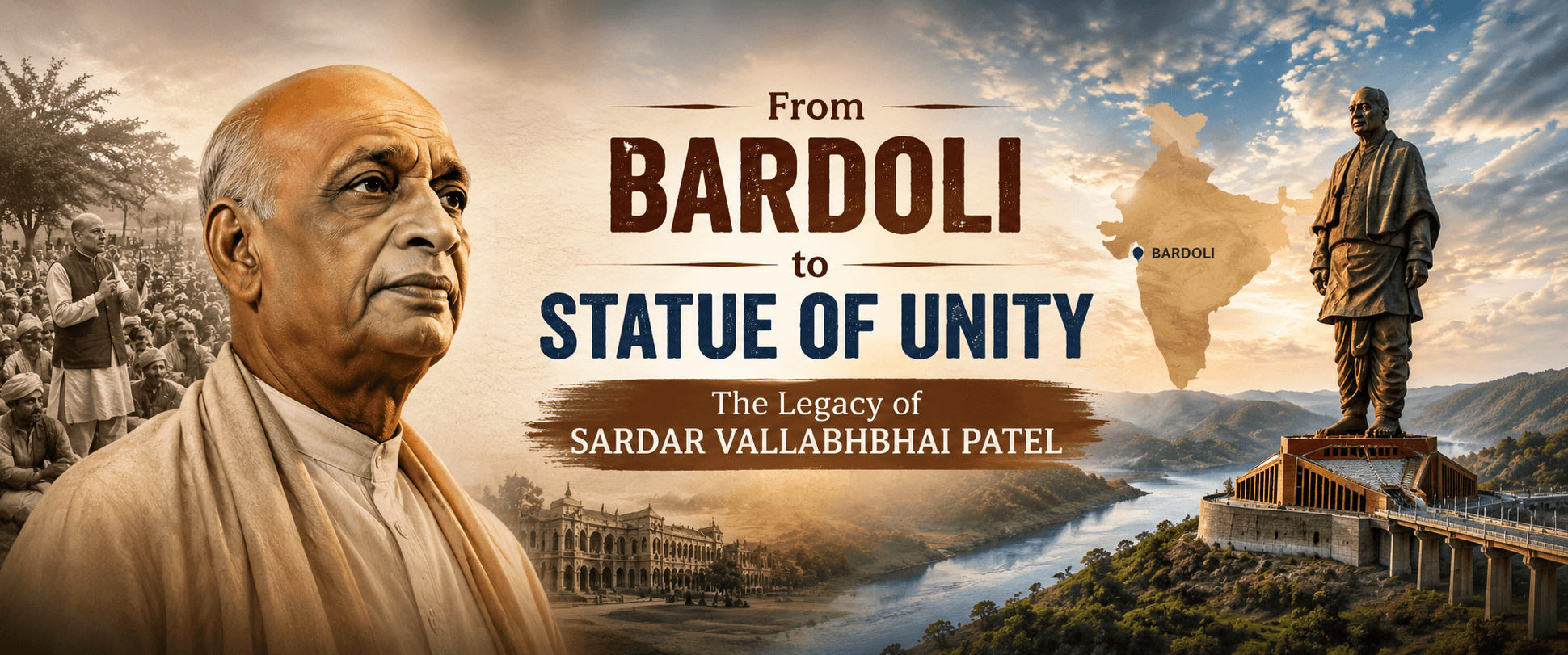


From Bardoli to Statue of Unity: The Legacy of Sardar Vallabhbhai Patel
India’s history has a lot of leaders who pushed change forward, but honestly very few left behind a legacy that feels as strong as Sardar Vallabhbhai Patel. People call him the Iron Man of India, and Patel helped in a major way to shape the nation after independence. His path, from the historic land of Bardoli to that huge Statue of Unity, isn’t simply a tale about leadership , or something neat like that. It’s more about grit and stubborn resolve , along with a kind of togetherness, national unity really, that still echoes today.
The Beginning of Sardar Vallabhbhai Patel’s Journey
So the tale of Sardar Vallabhbhai Patel kind of starts in Gujarat, like really there. He was born on 31 October 1875 in Nadiad, and yes he came from a simple farming family. Even in his younger days, people noticed he had a strong will, real discipline, and a sort of fearless nature, you know.
Before he ever stepped into politics, Patel worked as a successful lawyer. His quick mind and practical thinking brought him a solid reputation. Still, everything turned around after he met Mahatma Gandhi. Once Gandhi set out his vision for India, Patel got pulled into the freedom movement and he became one of the most forceful voices against British rule.
What also stood out was his closeness with common folk, especially farmers. That connection made him different, from a lot of leaders around that time, in a very quiet but strong way.
Bardoli: The Turning Point
The historic movement in Bardoli became, like, one of the biggest chapters in Sardar Patel legacy, i guess. In 1928, farmers in Bardoli were really suffering due to unfair taxes imposed by the British government. Patel stood beside them , and led a peaceful protest against these taxes, without noise or much drama.
Under his leadership, the farmers stayed united and disciplined. The protest turned out successful, so the British government was pressured to cut down the taxes. After that win, the people of Bardoli proudly gave him the title “Sardar,” which means leader.
This movement changed Patel’s image in a serious way. The phrase Bardoli to Statue of Unity represents more than distance, it shows the rising of a leader whose influence stretched into the whole country.
Why Sardar Patel is Called the Iron Man of India
The title “Iron Man of India” was given to Patel because he had this strong stubborn will, and fearless sort of command style. After India got independence in 1947, the country ran into one of its biggest troubles. Like, more than 500 princely states had to come together, in one united India, and it wasn’t exactly easy.
Back then, there was a real worry that India might split up into several separate regions, almost like a patchwork. Patel kept working day after day, trying to persuade the rulers to merge with the Indian Union. With a mix of quick understanding, steady patience, and firm discipline, he managed to bring those princely states under one umbrella.
What he achieved still counts as one of the best leadership stories in Indian history, even now. Honestly, without Patel’s efforts, modern India could have looked very different today.

Sardar Patel Contribution to India
The Sardar Patel contribution to India goes far beyond politics. He helped create a strong administrative structure for the country and believed deeply in national unity.
Some of his major contributions include:
Integration of princely states into one nation
Strengthening India’s civil services
Supporting farmers and rural communities
Promoting discipline and national responsibility
Building a foundation for a united India
Patel believed that unity was India’s greatest strength. His vision continues to inspire millions even today.
History of Statue of Unity
The History of Statue of Unity began as a tribute to Sardar Patel’s contribution to the nation. The statue was announced to honor his efforts in uniting India and preserving the country’s integrity.
Located near Kevadia in Gujarat, the Statue of Unity was inaugurated on 31 October 2018, on Patel’s birth anniversary. Standing at 182 meters, it is the tallest statue in the world.
The monument overlooks the beautiful Narmada River and attracts visitors from across India and around the world. More than just a tourist attraction, it serves as a symbol of national pride and unity.
The Statue of Unity history reflects India’s respect for a leader who dedicated his life to the country.
Statue of Unity India: More Than a Monument
Today, Statue of Unity India has become one of the country’s most popular tourist destinations. Families, students, history lovers, and travelers visit this iconic place to learn more about Sardar Patel’s life and achievements while enjoying the beauty of Gujarat through Unity.
The Statue of Unity is surrounded by many attractions that make the visit even more memorable. Tourists can explore:
Valley of Flowers
Jungle Safari
River Rafting
Glow Garden
Ekta Cruise
Children Nutrition Park
Cactus Garden
Arogya Van
Laser Light and Sound Show
The Statue of Unity attractions offer a mix of history, entertainment, nature, and family-friendly experiences, making the Statue of Unity more than just a monument.
Visitors can also enjoy beautiful views of the Narmada River from the viewing gallery inside the statue. The peaceful atmosphere and scenic surroundings make it one of the best travel experiences in Gujarat.
For a smooth journey, tourists are advised to complete their Statue of Unity ticket booking in advance, especially during weekends, holidays, and festival seasons. Online booking helps visitors avoid long queues and plan their travel comfortably. Different ticket options are available depending on the attractions and experiences visitors want to explore.
Many travelers also choose Statue of Unity Packages that include accommodation, local sightseeing, transportation, and entry tickets for major attractions around the Statue of Unity.
For many people, seeing the statue in person creates an emotional connection with India’s history, unity, and cultural pride.
How the Legacy Still Inspires India
Even decades after his passing, Patel’s thoughts still somehow seem relevant. In today’s fast-changing world , his message of togetherness, discipline , and national strength still matters in a way that people can feel.
Young people keep learning about his life in schools and universities. Leaders across different political backgrounds respect his role in nation-building even when they may not agree on everything. His legacy reminds Indians that real leadership isn’t about sheer power, it’s more like serving people, with honesty and courage , right there in daily choices.
The trip from Bardoli to the Statue of Unity feels like the trip of India itself— from struggle to resilience, from division toward unity.
Final Thoughts
The story of Sardar Vallabhbhai Patel Statue of Unity History is not only about some monument made out of steel and concrete. It’s kinda about the spirit of one man who had faith in a truly united India.
From guiding farmers in Bardoli, to getting together hundreds of princely states, Patel’s life carried a kind of relentless determination and useful service. The Statue of Unity stands today as a quiet reminder, of his unmatched contribution to the nation
And when visitors stand before that towering figure, they get reminded that firm nations are built through strong values.
FAQs
Comments (0)
No comments yet. Be the first to share your thoughts!